I have been a little neglectful here, but only because I’ve been flat out writing, directing, producing, editing, co-starring and churning out effects for season 2 of TARDISshorts.
Making a short film every week is quite labour intensive, so to make things easier I’ve also been making an extra conversational episode every week as well.
If you think that sounds harder rather than easier … well, yes. It turns out making two short films a week is even harder than making one short film a week.
The behind the scenes, “how we did it with no money and just a phone” info is all on our Twitter account and if you fancy finding out what adventures we’ve been up to after the Timelords took our TARDIS away then we’d be over the moon if you subscribed to our YouTube channel.
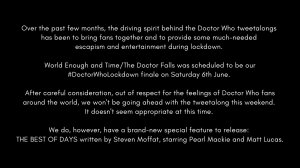
On the 30th May, Emily Cook announced the final Twitter watchalong would be World Enough and Time and The Doctor Falls on 6th June. That gave us 7 days to film our own #TARDISshorts finale.
We knew after the last two-parter that we wanted a cliffhanger and that the ending would involve a Timelord taking the TARDIS away from us for the events of Mew Earth … but being a sentimental old fool I didn’t want to end on a sad note, so I decided to sneak in the hint of adventures yet to come.
We worked out pretty quickly we needed to have some Cybermen and that the basic structure would go:
EPISODE ONE
On the run from the Timelords
Hide in a black hole
Something, something cybermen!
Daughter is about to be converted, dad is locked in TARDIS da da dah …
EPISODE TWO
Dad bursts out of TARDIS and rescues daughter
Escape in TARDIS
Get caught by TImelords
TARDIS gets confiscated
Dumped on beach, meet future daughter, receive TARDIS crystal
Which, as you can see, means we had absolutely no idea what the actual cyberman story would be.
But never mind, that’s just details. We can ignore them.
More pressingly we needed a Cyberman, a Timelord and a grown-up daughter.
For the Timelord I contacted a guy (Russell) I know from the (currently defunct) TARDISbuilders.com forum. He lives in Worthing and I’ve never met him, but I’ve seen his TARDIS is in Brighton, we have a vague connection through Kung-Fu and more importantly he has a homemade Timelord costume.
Largely papier-mache but it looks great.
I messaged him and luckily he agreed so we were one third of the way towards our guest cast.
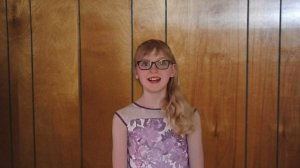
For the grown up daughter we could have used my wife/her mum but she has completely different coloured hair and doesn’t really like being on screen that much, so instead we asked our friend, Robyn, to help out.
Luckily she agreed too.
Which actually presented a new problem – they both needed lines to learn.
I may have explained before, but I’ll do it again anyway – there are no scripts for the TARDISshorts. We just get a vague idea in our heads and then start filming, making it up as we go along. Obviously that doesn’t work when other people are involved. Especially since Russell was going to film his part and send me the video.
So I bashed out a few pages and sent them to the relevant people. Despite being a scriptwriter, this felt very weird. I don’t like writing out of order and I know the first few pages of any script will be trash. I always junk the first ten pages or so when I get to the end of a script because by then I actually know what they need to convey and set up. Writing them cold knowing they’ll be fixed forever is awkward … but there was no other choice.
As it turned out, Russell couldn’t send me the video (technical reasons, no idea why) so he suggested doing it live over Google Hangouts and me recording it my end.
I don’t use Hangouts but I assumed it would be easy to figure it out so I agreed … but then couldn’t work out how to record the chat. In the end I just pointed my phone at the computer screen and recorded him that way. Between the awful lag of my laptop and the atrocious speed of our internet that day … yeah, well … luckily he was on a viewscreen darting in and out of the time vortex or something so the poor quality didn’t really matter.
On Tuesday the 2nd it looked like the beautiful weather was going to be a bit grim for the rest of the week, so Robyn popped down to the beach after work and we shot her scenes first in a suitably socially distant manner.
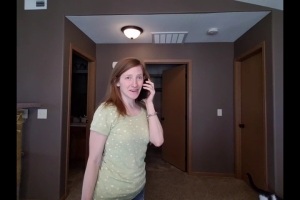
Hopefully the hair colour, the glasses and the outfits help sell the idea they’re the same person.
Frustratingly none of the audio came out so we had to rerecord it later and it still sounded awful. I tried to hide the weird unbeachlike echoes but ended up burying the dialogue in the mix. The version above is a remixed version, but it’s still barely audible.
I’d also written far too much dialogue for our 140 second running time so it got chopped down a lot. Part of what’s missing is her lamenting my death and telling her younger self to enjoy the time we have left … so, you know, no bad thing having to drop it.
Robyn had already starred in a TARDISshorts episode, by the way:
As herself, named quietly at the end using her real surname. So if you want to get all headcannon-y about it, I guess my daughter grows up to marry one of my best mates sometimes before she’s actually born.
Personally, I try not to think about that.
With the bookends done I just had to get myself a Cyberman.
I toyed briefly with 3D printing a Cyberman head, but the lockdown has left plastic-embarrassed and I just don’t have enough PLA to print anything that size. Besides, a week to print, sand, fill and paint a full head mask is a bit tight. Besides World Enough and Time is about the original (ish) Mondasian Cybermen so why not make that one?
It’s a damn sight easier for a start.
So I delved into the shed of wonders and came up with a pile of plumbing parts and some silver sticky-back plastic.
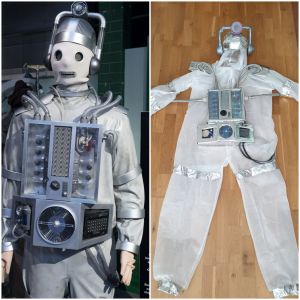
Chuck a bit of cardboard into the mix and some regular inkjet-printed stickers and I got this:
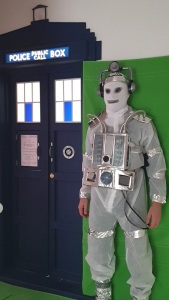
Add to that a £5 protective suit, some more pipes, a plastic cup, some gaffer tape, silver tape, half a pair of white leggings and a couple of those cap things you fill with washing up liquid and put in the washing machine and we arrived here:
£5, incidentally, is the entire production budget for this “series” of films.
I love the result. It’s shonky and wobbly and clearly made of gaffer tape, but it fits our homemade, zero-budget aesthetic beautifully.
I finished the cyberman at 10.20 on Wednesday evening. At 11.00 I read this on Twitter:
If you’re reading this in the future and don’t know what happened, look up George Floyd and the Black Lives Matter protests and you’ll understand.
World Enough and Time has a black person shot in the chest and killed. When she’s reanimated as a cyberperson she’s not allowed to express her emotions about the event and has to suppress them.
Cancelling the tweetalong was the right thing to do.
Which left me with a bit of a dilemma. Obviously we couldn’t just carry on with our planned homage of an episode which was cancelled for being insensitive.
I thought about cancelling our finale too, but in the end decided to pivot away from World Enough and Time/The Doctor Falls and towards The Tenth Planet/Twice Upon a Time.
If you’re not fluent in Doctor Who that’s the final episode of the first Doctor, William Hartnell and the final episode of the Twelfth, Peter Capaldi. The Tenth Planet is the debut of the Cybermen and takes place in Antartica in 1986, Twice Upon a Time (although filmed over 50 years later) slots into the final five minutes of that 1966 episode.
Because we hadn’t filmed (or even thought of) anything to do with the Cybermen yet it was really easy to change the black hole location to the South Pole.
And they even rhyme.
On Thursday the 4th June we filmed the TARDIS interior shots for the last time … and messed them up.
In order to get the lights on the console bright and the roundels lit up nicely I kept the room lights off. This caused two problems:
It was too dark and the phone camera had to work hard to compensate, the resulting footage being very grainy.
The light outside was so bright it washed out the green towel over the window making it very, very difficult to chroma key Russell in later.
So … yeah … those scenes look awful.
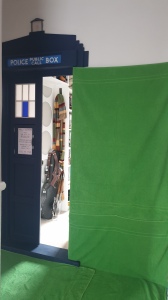
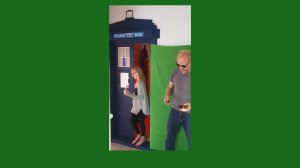
For the shots of people stepping out of the TARDIS we threw up the green towels across the right hand post:
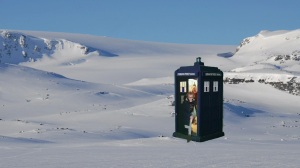
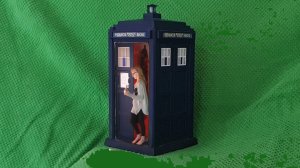
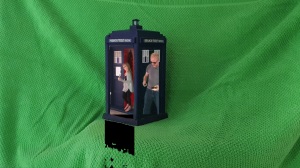
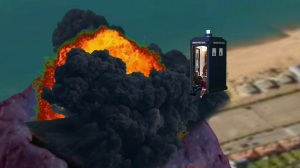
Layered those shots on top of the now familiar model shot:
And then replaced the green towel background with a static shot of the Antarctic. Or maybe the Arctic? Who knows?
That all done it was time for my favourite moment from any of the TARDISshorts. Like I say, originally I had no idea why I was left in the TARDIS while my daughter was taken for cyber-conversion nor how I was going to escape and rescue her.
She would normally rescue me, because I play the idiot in most of these episodes … but if I was the Cyberman and the one being converted … well that’s tricky to pull off.
Initially I thought they might have left me behind because I was too old or too ginger or something … but ultimately settled for what you see, me staying inside. There wasn’t enough time for an outdoor adventure anyway.
My first thought was I’d strap on my DL-44 (Han Solo’s blaster) holster and fight my way out gunslinger style …
… but then I thought about this being the last TARDISshorts episode and all the toys I never got to play with, the lightsabers, the proton pack, the myriad of Kung Fu weapons … oh and then there’s this guy:
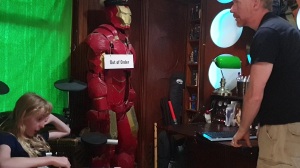
Built for a friend’s kid’s birthday party five years ago, Iron Man has stood proudly in my office ever since, decaying slowly since he’s just cardboard. I have 3D printed myself a new suit … but it’s not assembled or painted so the old cardboard version stands guard.
I spent most of Tuesday reinforcing his groinal injury with cardboard and hotglue, changing batteries, polishing off the dust and generally bringing him back to wearable condition.
I love the juxtaposition of Iron Man and Cybermen – both are cybernetically enhanced, but Iron Man is a removable option whereas cyber-conversion is permanent. This to me sets off the episode’s theme of running around in a TARDIS being great fun … until you can no longer go home. Temporary is brilliant, permanent … not so much.
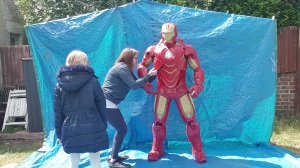
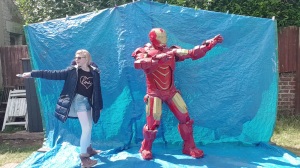
So we filmed Iron Man bursting out of the TARDIS and then went outside to our improvised green screen studio:
A tarpaulin slung over the washing line.
Although, due to the green being very dark and my daughter’s only winter coat being a dark blue it seemed better to flip it over and use the blue side:
Hence the neighbours looking down on this scene:
And then, after a quick costume change and a bit of TARDIS guarding cyber-action:
… we subjected them to a bit of this sort of thing:
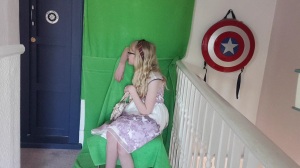
These two shots show the limitations of our chroma key technology. In the first one, upstairs against a green towel, The Cyberman’s headpiece is just level with the top of the towel. This means a half step forward puts the headpiece above the line and it gets cropped out of the shot.
If I were doing this on anything more sophisticated than a phone I could probably draw around that bit … but I’m not, so I can’t.
Outside, against the blue screen we have a similar height problem. You can see my left hand goes above the level of the washing line and would have disappeared if I hadn’t had the bright idea of using chroma key to replace the green leaves with a close up of the same blue tarp.
This only barely works.
The angle of the washing line on a single central prop isn’t much fun to crop around either. It seemed like a good idea when I was in bare feet and just a t-shirt, but in boots with a cup on my head I was perilously close to the top at all times.
Because we still didn’t know what was going to happen between Iron Man blasting a few Cybermen and my daughter escaping her conversion, we shot loads of this sort of thing:
With the opposite reactions from the Cybermen thinking it might cut together into some sort of running Iron Man/sonic screwdriver/Cybermen battle as we fought our way back towards the TARDIS.
Ultimately, with only 140 seconds to get out of the TARDIS, rescue my daughter, get caught by the Timelords, get abandoned on a beach and meet her future self … well, there wasn’t time.
Besides, one of the many, many downsides of being a two-person team (with the occasional wardrobe help from my wife) is there’s no one behind the camera while I’m wrapped in cardboard or tin foil. There’s no one to spot when we wave our arms outside the green (or blue) screen or when your daughter undoes her dark blue coat to reveal shorts the same colour as the backdrop or when Iron Man’s abs rotate 90 degrees to the left … so most of the footage was unusable.
Despite the last minute change of story and the technical issues of filming yourself fighting yourself in two different costumes, I’m so proud of our final TARDISshorts episodes.
If I achieve nothing else in my life beyond Iron Man emerging from a TARDIS to shoot Cybermen then I’ll die happy.
Except, of course, this isn’t going to be our swansong.
It was going to be, but … hey, we’ve got nothing else to do so …
So we’d filmed all the car scenes, all the interior of our house and the TARDIS scenes … we just didn’t know how to put them all together.
I knew we were going to end with the Timelords shouting at us from inside a Superman the Movie-style cloud about interfering with human history because, after exhausting other options, we’d gone back in time and stopped the zombie outbreak from ever happening.
But what were the other options?
More pressingly, how do you place green screen zombies outside a car window when we’re moving in front of the window, the camera is handheld and your effects app doesn’t allow for tracking?
I still don’t know the answer to that one.
First thing the next day (about lunchtime which is as close to first thing as I like to get) we reshot those car scenes with green towels over the windows.
My solution was this:
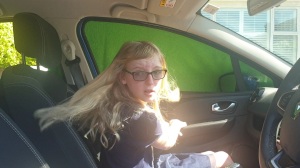
Film my daughter in the car with a green towel covering the window:
She gets out, removes the towel and walks away while the camera’s still running.
So we now have a shot of the real view from the window. I found some free-to-use zombies on YouTube:
… and then layered them all together like this:
As you can see there are two layers of the front zombie to make it look like she’s behind the pillar. One is cropped horizontally, the other vertically. There’s probably an easier way of doing this … but I don’t know what it is.
Oh … I could add an image of the house cropped to just the pillar I suppose? Not sure if that’s easier or not?
So that’s all well and good for my daughter because she doesn’t weigh anything. However, as I discovered later, I do weigh a fair bit and when I get out of the car the car rises on its suspension. Since the camera is on our improvised tripod outside the car, that means the angle of the shot changes and the window mask doesn’t quite line up.
Bugger.
Still, never mind. Hopefully people are looking at the zombies and not the weird camera angle differences.
A happy accident here was discovering the green hedge across the road, the one visible through the rear window, acted as a green screen and allowed me to insert a zombie.
Although I’d love to know what this passerby (seen through the rear window) thought was happening:
This was Friday the 29th of May, by the way. A scorchingly hot day with sunshine so bright it in no way matches up to what we shot at about 5 in the evening the night before.
Shh! Look at the zombies! The zombies, people!
After assembling some of the zombie footage I began to think it was a bit scary for what we were doing. I have no idea how young some of our audience is so I decided to add the kittens meowing to lighten it up a bit.
I even added one to a passerby in part one because it amused me immensely and that’s largely the point of these things, to amuse myself.
So we had zombies! Hooray!
We needed a quick reshoot of my dialogue in the dining room in part one to fill a few gaps and episode one was pretty much done.
Episode two was still a problem though. I still didn’t know what we’d be doing between getting into the TARDIS and deciding to break the laws of time. Or the rules of time. Laws, rules, one of them.
What would you do? What did we need to do? We’re searching the present for answers, but can’t go into the future or the past. Who would you go to? Could I drop us into footage of The Nutty Professor and go ask Jerry Lewis? It felt like we had to go and ask someone … and then I remembered this footage:
It still bums me out that no one will ever see that. I liked the project, I liked the footage and I really liked writing for Sylvester McCoy.
So I decided we should go and see the Seventh Doctor during his ‘hiding in a shed and talking shit’ phase. It wasn’t really covered in the show but I’m sure Big Finish will do a series on it one day.
I dragged my daughter out to our shed to shoot our responses and hoped he wouldn’t be too cross if he found out we were using the footage. Surprisingly, out of the 5000-odd Doctor Who fans who saw the video on Twitter, less than zero of them commented on the fact he was even there.
We had two more shots we need to do before filming was done. One was getting my long suffering wife to stand in the shadows of the bedroom and pretend to be a zombie:
This was because there was no way to drop the zombie into the footage we’d shot the day before. Or rather, there was a way but it was rubbish and my daughter was never quite in the right place.
Not her fault, I hadn’t told her where the zombie would be or even figured out how I was going to put a zombie in there.
The second shot was to add me into the “Oi, Alien! Get off my planet!” scene because we’d just made a big thing of doing this together … only for me to hide in the TARDIS and let her get on with it.
I didn’t have a clear shot of the door we’re standing in front of either, so I had to build that out of snippets from the Mr Bean clip.
Given longer than 3 minutes to do that I would have flopped it all except the sign so it looked like it was actually in the same room. In my head it’s a different door across the room so it’s all good.
With that edited in, all we had to do was film a montage explaining that Sylvester was our last hope of curing the virus, therefore setting up how his inability to help drove us to angering the Timelords.
In order to stay below the Twitter limit of 140 seconds we had to do all that in exactly 6.5 seconds.
Once again I took to Google, this time searching for images of the TARDIS on different planets and then inserting less than a second of each of them.
The resulting montage made me feel sick, so I recut it trying to make the TARDIS appear in roughly the same spot each time. Hopefully your eyes will track it across the screen until it lands outside the Shed of Eternity.
I think we ended up achieving all the things we set out to do with these two episodes. If I had one takeaway from the experience I would say plan your chroma key shots out properly. You know, maybe actually have a plan before you start shooting.
If I had two takeaways, the other would be “don’t halve your shooting time whilst doubling your running time and assuming you can easily add in hundreds of zombies”.
Still, despite the stress this was a few firsts for us: our first car shots, our first cliffhanger, our first (unwitting) cameo from famous actors.
The end result is a bit of fun which was created entirely between the hours of 5pm on Thursday and 1pm (ish) on Saturday … so I guess at least I can’t complain about it being much of a waste of time.
With this done and the finale of the #DoctorWhoLockdown tweetalongs being announced we had a week to prepare ourselves for the #TARDISshorts swansong …
I’m a little bit behind with this, our #TARDISshorts series being finished, but for the sake of completeness I thought I’d finish these posts in order.
On Tuesday the 26th May 2020 Emily Cook announced the next #DoctorWhoLockdown tweetalong would be a double bill of New Earth and Gridlock on Saturday the 30th.
This gave us four days to come up with the next #TARDISshorts episode, but for reasons I can’t quite remember we didn’t start filming until the 28th … and then decided to make it a two-parter.
This is what we came up with:
I loved the idea of doing a two-parter because cliffhangers are what made Doctor Who so terrifying as a child. Three out of every four Saturdays we went to bed thinking the Doctor was dead or dying. Not like you namby-pampy youngsters who get a happy ending nearly every week.
Life was tough back then.
And deeply, deeply upsetting.
So I knew we wanted a cliffhanger … but that’s about all. We made a list of things from the two episodes: viruses, cats, hospitals, the last human, cars, the beach where I proposed to my wife … and it seemed like a good opportunity to do a zombie story.
Now, I must confess I’m not great with zombie films. I think I like them but about halfway through I start hoping the heroes get killed because the whole world is so terrifying and hopeless that death seems like the best and inevitable option.
But these are Doctor Who themed shorts so they have to have hope and solutions. Plus I didn’t fancy shooting my daughter in the head in order to just get it over and done with.
We also found out that this would be the penultimate tweetalong, so it would probably also be the penultimate #TARDISshorts.
Probably.
So the second half had to hint at some kind of winding up of the series. Not that it’s really been a series or even had much of a story, but I guess I wanted to finish on something a bit more coherent.
And that’s what we ran with basically. Zombies, cars, ending the series.
The cliffhanger felt like a fun one so we built up to that and the final resolution came from something my dad said to me in the late seventies. We’d just found out there would be a sequel to Superman the Movie and were speculating about its content. My dad thought it might be Superman getting into trouble for interfering with human history.
Not sure who was going to be cross with him since his entire race was dead but it sounded like a cool story.
So that went into the pot.
A vague idea about cars, zombies, a cliffhanger with us stuck in a car and Timelords being cross with us inside clouds was about as much information as we needed to start filming.
The first shots we did were the car shots … which meant I had to clean it first. There are a LOT of seagulls around our way and they hate cars with a moist white passion. By the time we’d done all our other jobs that day and washed the car it was about 5 in the evening so we were a wee bit behind schedule.
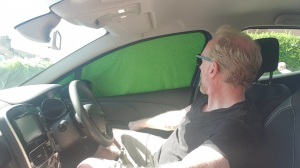
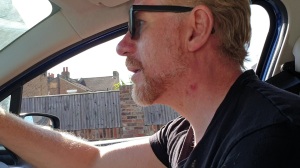
We did the inside shots first, some of which were easier than others. Shots of me driving are fine, my daughter just holds the phone.
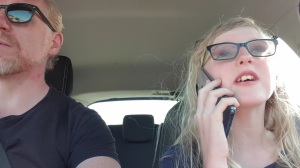
Shots of us both in a moving car are easy because I have a vent-mount for my phone. Even if it does cut me off a little.
Shots of my daughter while I’m driving … not so easy.
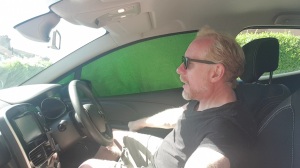
We had to break out the trusty green towels for that one. I suppose I could have held the phone and driven with the other hand, but that’s both illegal and stupidly dangerous … so chroma key was the answer.
It was stupidly hot that day and we couldn’t put the air-conditioning on whilst the phone was on the vent mount because it would sound like we were in a hurricane, so for the stationary shots we just wound the windows down. After all, I thought, it would be easier to green screen the road without all those reflections.
Not sure that’s the right kind of thought to have at these times, but hey ho.
Dropping the travelling road in was a bigger problem. Initially I thought about getting my daughter to film the street while I was driving … but then how would I put the zombies in?
As I’ve mentioned before, these are all filmed and edited on my phone. The app I use, Kinemaster, doesn’t allow for tracking when layering on green screen effects. In other words, if I put the zombies into a moving shot, they would float along keeping pace with the car.
Pretty certain that’s not how real zombies behave.
I needed a stationary shot which I could then pan along. So that’s what I did … and then found out a single shot is in no way long enough to pan along. As soon as you zoom into one end it looks like I’m driving in people’s front gardens. Or scraping their houses with my wing mirrors.
That was a moment of despair late on Thursday evening as I was trying to cobble together the effects.
My solution the next day was to take a few panoramic shots:
That way I had plenty of time to pan along adding stationary zombies to the image. The mistake I made there was standing in one spot and turning to get the panorama. This resulted in the curved images you can see. What I should have done is start the panorama and then walk along the road in a straight line … but I’m not sure that would have given me enough distance from the superimposed car to the houses. Not sure how I’d deal with parked cars on my side of the street either, without shooting above them and making it look like my car was six feet off the ground.
The stationary shots of us being attacked by zombies were easier. We just filmed from the vent-mount and then from each side …
That’s me trying to be upset about zombies without upsetting the neighbours.
That’s her “Thor holding open the aperture in Infinity Wars” face, apparently.
I was horribly aware doing these shots that we had the windows open (to prevent death by boiling) and were in a quiet residential street. Hence my whispering my “Argh there are zombies!” screams.
A few years ago my brother moved to America, so I made him a Blake’s 7 teleport bracelet as a reminder to keep in touch.
I also took the opportunity to make one for myself and a spare for a friend I thought might want one. Which he did.
This seemed like a geeky way to teleport from the car to the TARDIS in part two.
Moving to the exterior of the car we set up a tripod … well, not a tripod, a selfie stick duct taped to an old speaker stand … on the pavement and then ran around trying not to look too weird to the neighbours.
The nose shot of us pulling up outside our house was done the same way. A friend expressed surprise that we’d just leave my phone sitting on the pavement while we drove off … but it’s a nice area. Or a crappy phone. One of the two.
Everything inside the house was simple, just point and shoot. The only time the towels came out were for the TARDIS interior so we could see an elevated view of Eastbourne out of the window.
At this point I still didn’t know what that view would be, just something high up. To be fair, I still didn’t know how we were going to do the zombies at all, but I assumed I’d just figure that out later.
Never approach filming like that. It’s silly.
For the shots of us looking out of the TARDIS we just filmed it in portrait …
… and then combined it with the same green towel model shot we’ve used throughout these shorts.
We can only film my office door from that one specific angle and although the model angle isn’t quite right, it’s close enough to not make it worth reshooting.
In Gridlock the situation is solved by visiting the government building and discovering the truth. Initially I’d toyed with doing something similar. I thought we might go to the zombie-infested Houses of Parliament and find the outbreak was caused by an idiot chemist called Boris Johnson. We’d go back in time and stop him becoming a chemist, return to the present and find out he’d become the PM instead.
Or something. As you can tell, it wasn’t a thought I entertained for long.
I looked for footage of young Boris, but not very hard and couldn’t really find anything useful so I gave up that idea.
Besides, intimating that the PM was the cause of a deadly virus seemed unnecessarily upsetting in the present climate.
Having Mr Bean cause the accident came about because I was just looking for footage of idiots and chemistry I could borrow and this came up.
Making him an alien … well, he is isn’t he? Isn’t that the premise of the character? Imbecile alien investigates Earth?
By the end of shooting on the first day I still didn’t really know how to get from the emergency teleport scene to this green towel shot of my daughter throwing Mr Bean off the planet:
Nor did I know how to actually put the zombies into the footage. I thought I’d figure it out.
I was wrong.
In the house, fine. In the street, no problem … but outside the car window while we’re moving around in front of them and the camera is handheld?
Not a chance.
When I eventually went to at stupid o’clock the next morning I was in a bit of a panic … but I’ll deal with that in part two.
If you were wondering what the hell was going on in this episode, then congratulations! You’re not alone.
If, on the other hand, you got the gag and thought it was funny … congratulations! You’re not alone either.
There’s not really much to explain about this one other than the perhaps the point.
After the lasttwo extremely intensive shorts, and with another three day window, I just wanted to do something short and simple. Visually I wanted it to look like a bad art/film student short film. Black and white with lots of silence and moody staring. The kind of thing which could be considered high-art … if it just weren’t quite so awful.
The whole thing is constructed around a bad pun on the title of the Doctor Who episode we were watching. Obviously the rings in this case are telephone rings instead of rings of a planet.
The long, somber, over-dramatic opening credits are just to increase the build up to the bad throwaway pun. The challenge there was to balance the drama, the humour and the pomposity. Hopefully that worked.
There’s nothing else going on, it’s just a shaggy dog story.
Filming wise, I just pointed my phone at my daughter and told her to look cross. The whole thing took about ten minutes.
Effects wise there’s nothing going on. Just a colour filter which strips out everything except blue.
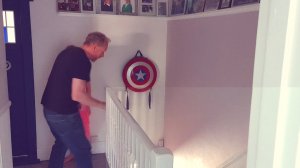
I did have to create a black and white layer for the right hand side of the screen so that the Captain America bag didn’t have a blue centre, but that’s about it.
Weirdly, I still see the colours in that shield. Even though I know it’s black and white.
Similarly the TARDIS looked black and white even though I knew it was blue. I just upped the colour saturation there to compensate.
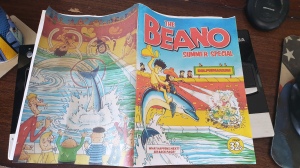
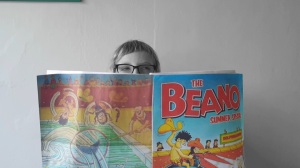
The only prop built was the Beano:
Which was made to replicate the one Matt Smith read in the actual Rings of Ahkaten:
It’s a lot smaller and it doesn’t have the date, but for a throwaway gag it’ll do. The insides are just a few sheets of paper, just to give it depth:
The drumming music came from here:
And the spooky bells/chimes came from here:
Both of these people are incredibly kind to upload their music for use in silly projects such as these.
And that’s it. It’s a two minute exercise in trolling. A massive dramatic build up leading to a terrible pun and a nonsensical ending, all wrapped up in a shell designed to mimic the kind of terribly pompous films I’ve often been subjected to at film festivals.
Given what the intention was, I’m immensely proud of it. It makes me giggle and that’s all it was meant to do.
The next one should be out on Saturday: a two-parter with a our first cliffhanger!
This is probably our most effect heavy #TARDISshorts yet. Which, coming just 3 days after the last one was exactly what I said I didn’t want.
Still, it was fun so who cares?
Wednesday evening we found out An Adventure in Space and Time would be the next one, which in one way was great because I’d already thought about what to do … but in another way was less great because as I explained last time I’d already burnt that idea.
So Wednesday I went to bed needing an idea for the following Saturday. Thursday morning I still didn’t really know what I wanted to do, which was a problem.
Time, as always, was running out.
I should reiterate at this point, no one is paying me to do this. No one is even expecting me to do it, but I’ve got into the habit and it’s now become my weekly challenge.
A weekly challenge which was now happening every three days.
So I had to do something, even if I had no idea what. The only thing I had in mind was this scene from An Adventure in Space and Time:
That scene made me cry when I first saw it (and every time since, although it’s been a while) and I just thought it would be funny to subvert it and have my daughter waiting nervously there instead.
I built the rest of the story around that and a few scraps of 1960’s London footage I could find.
With no time to really think about it (I was busy the rest of the day on Thursday), that would have to do.
I asked my friend Mark Sweeting (who you may or may not have seen in our Dalek Loop #TARDISshorts):
… if he’d be willing to play a 1960’s BBC security guard and he was.
Which caused another problem: I had no idea what they looked like.
I should point out at this stage that I’d completely forgotten William Russell plays one in An Adventure in Space and Time. I wondered vaguely if there was a guard in there somewhere but a quick scan through at super high speed didn’t reveal one, so I took to the internet and this was all I could find:
Which gave me the general shape, if none of the details.
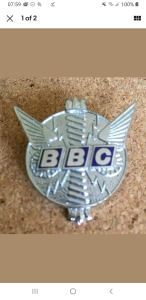
A bit more research and I found these:
Which are either cap badges or collar badges or possibly both. But which one to use? The top one is apparently from the ’50s and the bottom one is from the ’70s. Which did they use in the ’60s?
No idea, so I picked the bottom one because it’s a clearer logo … one which can’t be seen on screen anyway.
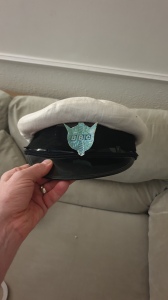
I lucked out with the hat because my dad used to be in the merchant navy and I have his old cap:
Well, technically Iron Man has it, but I managed to get him to swap it in return for some new pants:
I didn’t want to damage the cap (because of its significance to me) but luckily the cap badge is on a reversible band. So I printed out the BBC badge, stuck it to some card and then, in best Blue Peter fashion) used double-sided sticky tape to affix it to the reversed cap-band.
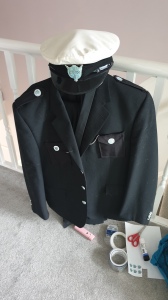
For the rest of the uniform I broke out the sewing machine and dug through my bags of scrap material until I found the bits I needed to customise an old black suit:
That, I thought, would do. I covered the buttons with silver tape (and added the BBC logo for good measure), added the epaulettes, the chest pockets and the chain. As an afterthought I added one more button because the image I found had four and four just looks more security guard than three.
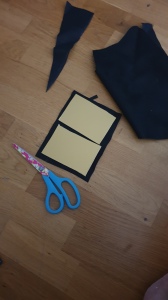
This was all late Thursday night. I also cobbled together a psychic paper wallet because my daughter really, really wanted to use one. In every film we’ve done, so it was about time.
It’s a bit wobbly, but it was late and I was tired. It’d have to do.
Friday morning and one quick socially-distant film shoot later …
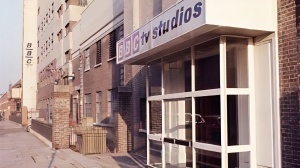
And I had the footage to insert into this photo of the Lime Grove entrance:
I ended up trimming the wider establishing shot so I guess it could have been any entrance anywhere, but I know it’s authentic even if no one else does. I even went to the trouble of putting a reflection in the window because … well, that’s what windows do, isn’t?
But when I came to add us over the top I realised there was no way to create our reflection properly. If you watch closely (or not closely, depending on how obvious you feel it is) then our reflections are actually a separate take from the opposite direction. They don’t match and seem to be living in a different time line.
It was a nice surprise when we finally watched An Adventure in Space and Time on Saturday to see how close my guestimate costume was to the one they used:
Just needed some military ribbons really. Having said that, they went with the older cap badge and significantly more buttons. Not sure if the button count is accurate or if they just repurposed a naval/police officer uniform?
Either way, I’m happy with what I cobbled together in a few hours at short notice.
Friday afternoon my daughter and I trashed the TARDIS:
Threw up the green towels …
… and got to work.
As you can see we’re extremely limited by both space and the size/quantity of the towels. We had to be very careful how we lined up the shots to make sure neither of us went out of the green areas. Sometimes we even had to shoot it kneeling down:
Even then when it came to dropping us into the old 1960’s footage I had to crop each image twice. Because I can only crop in prearranged shapes I had to do one tall skinny rectangle to get my height and a second wide mid-level one to get my daughter’s head/shoulders in without seeing the TARDIS window peeping through.
To get us talking in front of the side of the TARDIS which doesn’t exist, I reused this model shot:
… layered it over the top of our real doors …
… to get this …
… and then us again over the side:
Before overlaying all of that over the street footage:
The windows still don’t quite line up but I’m getting closer. One day I’ll get it right.
There was only about 15 seconds of the street scene so that was on a loop. It’s also mirrored (you can tell by the shop signs) because it’s impossible to shoot the TARDIS from any other angle due to the layout of our house. I can’t flop the TARDIS footage because the signs and the doors would be backwards!
For the David Bradley/William Hartnell shot I made a custom mask using Paint.net (just cutting and pasting bits of the console) so I could have my daughter behind all the controls:
There’s a crop line just to her left (our right) so I could have a still image of the column stopped rather than going up and down.
I finally finished all the editing at about 3.30 am on Saturday morning and then crashed out for a few hours.
Early the next day I realised I didn’t really like what I had. There was a different bus scene where I’d tried to make a joke about the Back to the Future thing of carrying a suitcase full of money around with us, but it didn’t really work. Plus the scene I’d dropped us into didn’t really work.
There was also an extended “inside Lime Grove” sequence which was fine … but unnecessary.
I was trying to find a gag about the guy wandering around the corridor, but I can’t remember who he is! I know he’s from Nationwide, but couldn’t be arsed searching up pictures of all the presenters until I found out in the vague hope I coudl make a weak gag out of it.
I think that’s from the late ’70s anyway so it doesn’t really look right.
Quite late on Saturday morning I decided to add the On the Buses gag. Wrong time period again, but only a little bit and hopefully fudgeable.
I quite liked that so I added the Austin Powers snippets too, which helped bridge some of the longer dialogue in the TARDIS. Because we don’t script these, my daughter and I tend to waffle on a bit. Sometimes it’s hard to cut it down to a manageable snippet.
For example, the “I’m doing a TARDIS inspection line” was originally “I’m doing a TARDIS inspection to see if everything’s going to plan and all the buttons work and the technical things are right like the music and the lights and everything’s going okay.”
Which is slightly less succinct than a 140 second running time demands.
If I were to revisit this I think I’d have had us wandering through footage from every ’60s film and TV show I could think of … but I’m not going to, so I won’t. It’s an idea which came to me too late to use.
Overall I’m not sure how successful this one was. It feels very last-minute cobbled-together to me … but then that’s largely because it was.
Still, at least I’ve got until (checks notes) Tuesday to do the next one.
On Sunday night we found out the next episode in Emily Cook‘s Doctor Who tweetalongs would be Steven Moffat’s LISTEN.
I have to admit this through me into a bit of a panic. 3 days is not a lot of time to conceive, film, edit and add effects to a short film. Even one which has to stay under the Twitter limit of 140 seconds, but we managed it.
With a little bit of pre-shot footage cheating, but that’s neither here nor there. Unlike BOO!, which is here:
The genesis of this idea came from mulling over what I might do for various episodes. I’d been wondering what I might do if it was An Adventure in Space and Time, for example. How would I replicate 1963 in my house?
Not that it had to be 1963 because we’re only making these TARDISshorts themed around one element of the episode being rewatched. If, say, we were making one themed around the ‘beginning of something’ then we could pick anything. Centring that around my daughter could mean the conception (we’re not really making those kind of films) or how her mum and I met (difficult to replicate something from that long ago) or maybe even our wedding. For which there is footage and … yeah, I could probably drop my daughter and I into that old footage.
So that was an idea in the bank. Not much of an idea, just a vague thought.
When LISTEN was announced as the next episode I was a bit stumped. It hadn’t even crossed my mind and I had no idea what to do.
Helpfully my brain threw this old idea at me and combined it with my daughter’s annoying habit of jumping out at me like a pint-sized Kato (Cato?).
I rarely flinch externally. Internally all my organs leap about like startled cats, but externally I tend to react pretty much like I do in the film. This drives her mad. If she had a time machine she would do exactly what she does in BOO!
So the idea had arrived! Unfortunately at about one in the morning which kept me thinking until about 5 am … but it had arrived and that’s the hardest part.
The next day I went looking for our wedding footage (the oldest footage I have of us) only to find it had gone missing. I could find the ceremony and the song we played at the end …
… but none of the middle stuff: the speeches, the first dance, the confused game of croquet (only one person knew the rules and he was unable to explain them adequately).
And to be honest, the snippets I did have were terrible quality.Luckily I’ve still got the original DVD, very kindly made as a wedding present by a production company I was working for at the time.
Unluckily … a DVD! Fine, we have a DVD player, but how do you get info off a DVD onto a laptop during lockdown in 2020?
Nothing I own has a DVD drive. Nothing.
Luck came to the rescue again because one of my best friends had an all in one PC with DVD drive AND the inclination to help. A quick socially-distant visit (through a window, no less) and I had the footage on a USB drive … at five o’clock on Monday evening.
So that’s now two days to conceive, film, edit and add effects.
Eep.
Still, I had the footage. Now all I had to do was find about one minute of shots out of the total forty-five minutes which would cover the entire wedding from start to finish, convey the flavour of the day with each shot being still enough and having enough blank space to digitally insert my daughter.
This was beginning to sound less easy than I’d hoped.
That night Mandy and I rewatched the DVD and I made notes. Tuesday morning I managed to pull out about 6 mins which would do the job … which is too much, especially when you consider we still had to film the opening scare attempts, the landing, the breaking into the honeymoon suite, the entry of the bride and groom and the final scare.
6 mins down to 1 minute means harsh choices and I apologise if you own one of the faces which got cut out.
Still, I had the spine of the film. Now all I had to do was turn our house into a picturesque country hotel.
Which actually wasn’t that difficult. Assuming it was in anyway successful.
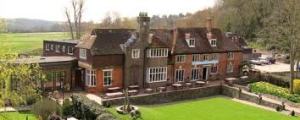
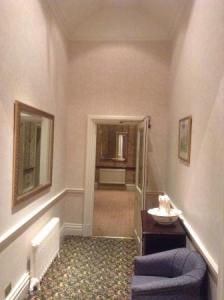
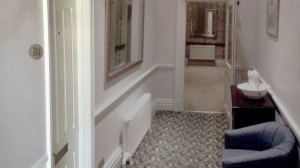
I started by trying to find photos of Deans Place Hotel’s corridors but couldn’t find anything suitable. So instead I just nabbed one which vaguely matched our decor:
And added our bedroom door:
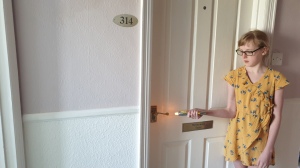
We don’t have that carpet, by the way. Nor do we have a peephole, room number or brass plate saying honeymoon suite. They’re there because I found this image online;
… printed the bits out, stuck the brass plate to card (for added depth) and Prittsticked them to the door.
Even in close up it seems to work well enough:
Although if I had more time I’d have made the cut a little neater on the card, maybe even coloured the edges.
The final touches were a fire evacuation sign for the rear of the door:
… and a completely anachronistic coffee machine + pods … which got cropped out of the final shot anyway.
The interior peephole is the same as the exterior, I just moved it from one side to the other during the shoot.
With all that prep done it was time to break out the green towels:
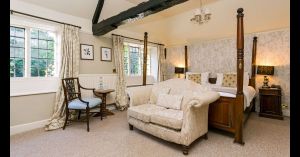
I managed to find a photo of a real room from Deans Place (albeit not the one we stayed in … or if it was, it didn’t look like that in 2005):
… but couldn’t find anything which matched the angle looking from the room into the hall. After a lot of fruitless searching I realised I could just take a photo of the hall downstairs:
Doh.
Originally I planned to have the TARDIS land in the hotel somewhere, possibly here:
Which isn’t actually in the hotel but is probably in a hotel somewhere. But I couldn’t get it to match up with the angle of the TARDIS footage so fell back on dropping the model TARDIS into Deans Place gardens.
Similarly I’d planned to superimpose my daughter against this backdrop:
Which seemed a good match for the actual panelling in the ceremony room … but it just looked odd. She was clearly in a room on her own.
In the end I went with the harder (and slightly worse looking) option of dropping her into the back of the actual room.
This was tough for me because of the inability to draw round people’s heads on my phone. I had to build it in layers, the bottom half of her is a hexagonal mask to fit around the heads of the people in front, the top half is a rectangular mask so it doesn’t cut off her ears, especially when she mimes being sick.
It’s not perfect, but it’s fleeting and … hey, it’s a two minute short film made by a father and daughter who don’t know what they’re doing. It’s fine.
The other major downside is the only available space (in shot) along the wall was behind the head of an ex-partner of a friend. I’d rather have had her behind her granddad or someone else I actually like, but I didn’t have a lot of choice.
Luckily there was a spare seat at a table full of my closest friends at the wedding breakfast which was in shot for most of the speeches.
Yay!
Annoyingly the handheld camera footage means my superimposed daughter looks like a floating torso for most of them, but it was the best I could do.
The last part of the shoot was Mandy and I dressing up (legs only)in our wedding gear (her dress, me in just a similar pair of trousers) and pretending the underneath of our divan bed was actually under a wooden four-poster.
Luckily the drawers pull out on both sides so we could shoot right through. Again, I think it works in passing. Depends how much you’re enjoying what’s happening.
The final mid-credits scene was an afterthought really. I just thought it was funny.
All in all we shot for a few hours in the afternoon and I finished the edit by midnight. I decided to lean into the 14:9 ratio of the 2005 footage and added the black bars over all our 16:9 shots whilst in the past. Hence the coffee-making station getting cropped out.
At about midnight on Tuesday I discovered there were too many effects in the film for my phone to cope with exporting the edit and after an hour or so of trying I had to give up and hope it would work in the morning.
It didn’t.
I still don’t know why, it’s not that intensive. Not compared to the Fires of Eastbourne.
But it wouldn’t work and so I spent a hurried Wednesday morning pulling out all the effects and adding them back one by one, exporting a copy each time. Ultimately I made my self-imposed 13.00 deadline but it was a bit gruelling.
I swear the next one (whatever that may be) will be four seconds long.
Last night we watched Doctor Who: The Fires of Pompeii as a Twitter watchalong and continuing our lockdown tradition, my daughter and I made a Tardis short themed around the episode:
This time I decided to enlist the help of friends and strangers to film the volcano-panic scenes. To this end we made this plea for help:
I hoped to get one or two people to submit something but was fully prepared to do it ourselves in a variety of wigs and costumes. Four submissions would have been ideal … we got seven, with an eighth arriving after the deadline (but more importantly just after I’d finished editing and adding all the effects) which was too late to use. There were other people offering to film them during the day on Saturday but I had neither the time nor the space to include them.
So first off, a massive thank you to everyone who filmed a segment, you were all brilliant! I’m blown away by how many people wanted to be involved. We had two from Eastbourne, two from America, one from Huddersfield, one from East Grinstead and one from Australia … the only problem was we didn’t have a volcano!
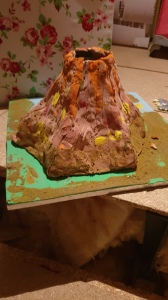
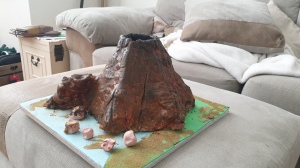
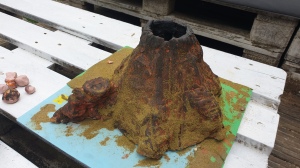
Luckily my daughter made one for a school project a few years ago (Year 4, I think?), but upon digging it out of the loft it became apparent it wasn’t quite as realistic as I’d hoped:
Still, I hoped that with a bit of paint …
… some fake grass …
… and the right angle against the right backdrop …
… it might just do the job.
The large circular piece on the ridge is a nest for dinosaur eggs by the way. In case you were wondering.
The next challenge was putting it into the background of other people’s photos using a phone app (because all of this is done on a phone) which doesn’t allow for custom masks or any kind of magic wand selecting. Some were easier than others and overall it worked out okay.
Providing you don’t look too closely.
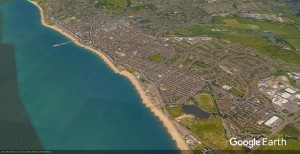
But in a few seconds of footage with volcano effects, sounds and screaming on a small phone screen … yeah, it’ll do. I photographed the volcano against a red towel (so the green of the fake grass didn’t get chroma keyed out!) from different angles to create the impression the houses are on different sides and then added a higher view to an image of Eastbourne culled from Google Earth:
Being able to view both the image and the camera using split screen was invaluable here. Not sure how I would have matched the angles otherwise!
Another challenge was figuring out how to include this interior footage from America into the film without making it seem completely separate.
My solution was to add a window with the volcano visible in the reflection. It’s not seamlessly brilliant … but I think it works (once again giving the small screen/low expectations caveat!).
With all that done and the fire, smoke and lava effects added, it was time to film our section.
This all went pretty smoothly really with no major problems. I broke out the green towels again so we could be looking out of the TARDIS at the volcano …
… and so we could be seen inside the TARDIS from the outside.
I wish I’d noticed that loop on the towel at the time.
The latter scene was cropped and overlaid on the model shot of the TARDIS we made for The Stolen Earth … which is fine except for one problem:
No legs!
To get round that we shot our legs against a green towel in the garden:
… using the removable step/base from the TARDIS doorway:
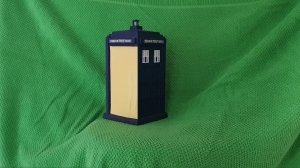
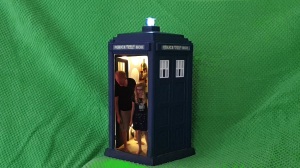
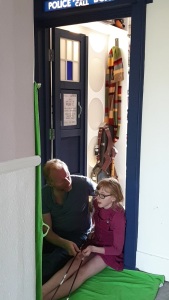
The TARDIS is designed like that because the room functions as a spare bedroom. The panel with lit roundels behind the desk/console folds down to reveal a bed so the desk and the chair need to be wheeled out to make room.
I didn’t fancy hoiking either of them over a step so I made it easily removable. Luckily it can also now be taken into the garden and sat on to simulate dangling your legs over an erupting volcano. An unintended but nevertheless helpful use.
My daughter’s legs look more natural than mine, but it’s so small I don’t think it’s too noticeable.
One thing I’ve been wanting to do for some time is make use of the window in our TARDIS. The normal view is this:
Which is fine when we’re landed at home, but not so useful when we’re in the time vortex. So out came the towels again…
And I was able to move move from being at home to the time vortex to high above Eastbourne in one shot. This wasn’t as good as I wanted it to be partly because the towel was folded over on the right hand side (making it a different colour green) and partly because the light was stupidly bright on the left hand side.
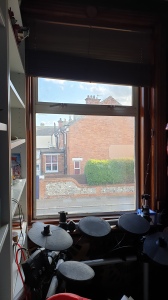
Oh and also the green light reflected off the black drum kit.
Still, I give myself marks for trying.
The last two shots which we picked up the next day were my daughter’s hands holding a phone against a towel to drop into the East Grinstead volcano shot:
Just because I wanted to.
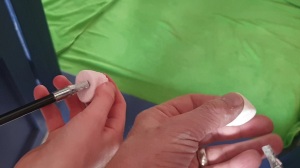
And a close up of the marshmallows being fitted to the sticks:
Because I was worried it wasn’t clear what we were doing otherwise.
Prop wise there wasn’t much to make for this short. The board game we were playing was designed and made by my daughter for another school project.
It’s called GET TO THE SHELTER! which I thought was apt. You have to collect enough bits to build an Anderson shelter during WWII. She wanted a TARDIS dice tower 3D printing, initially I tried to talk her out of it but … hey, it fits the period.
The only custom prop made was the Volcano Kit box. I was going to make a more official label but didn’t (because I hadn’t actually decided what it was going to be until on the day) and anyway it’s not meant to be an official, shop bought Volcano Emergency Kit. It’s just the box we keep sticks and marshmalllows in in case there’s an eruption.
It’s Emergency Use Only because my character would just eat the marshmallows otherwise. It’s not a difficult role to play.
It doesn’t actually hold the tent poles we used so you never see them inside, but if it bothers you just imagine it’s a dimensionally transcendent box.
I think this is one of the most effects-heavy shorts we’ve done. I kept saying the next one was just going to four seconds long … but then we found out it’s going to be Listen and all that went out of the window.
I should point out we only find out what the next watchalong will be on the night of the current one. Last night we found out the next one is on Wednesday, it’s Monday now and we need to get cracking!
Continuing on from the last post about the TARDISshorts my daughter and I have been making (each themed around whatever episode Emily Cook is hosting on Twitter) I thought I’d document a little about how each short was made.
Just to be clear, this isn’t a ‘how to’ post because (as will become apparent, if it already isn’t) I have no idea what I’m doing.
The filmmakers among you will already know how to do all this stuff. Most of you will easily spot the mistakes I’ve made and know how to solve them. I don’t. I’m literally figuring this stuff out as I go along.
I guess that makes this blog post a catalogue of errors. Or stupidity.
So without further ado, here’s this week’s short themed around Peter Harness‘ The Zygon Invasion/The Zygon Inversion.
The idea
I’ll happily admit this one was made in a state of mild panic. We only found out on Wednesday night that these episodes would be rewatched on Sunday. Thursday I couldn’t do any filming (because reasons) which left me with Friday to shoot and Saturday to edit.
Editing takes me ages because, as with everything else, I have no idea what I’m doing.
A day to think, a day to shoot and a day to edit sounds fine though.
Although it wasn’t a day to shoot because we only had the afternoon (the morning given over to shooting a Crossfit video for my wife). Nor was it a day to edit because I can’t just do this at the expense of all other aspects of family life.
Also, I had no idea what to do for this episode. I have a few vague ideas for episodes I think might come up. Next week’s, for example, I’ve had a vague plan of what to do for a month or so now. I didn’t know when, or even if, The Fires of Pompeii would pop up, but it had crossed my mind.
Zygons hadn’t.
So that stumped me for a bit. Initially I thought my daughter might want to play the two zygon/human parts and that it would be some kind of cheeky secret twin type fool your parents romp.
That sent me down a weird cul-de-sac for most of Thursday. We had loads of ideas, but no story. Especially one which could be told in 140 seconds, the limit for Twitter.
Eventually we decided to flip it because in this series I’m the idiot and my daughter has all the smarts.
Pretty much like real life.
The idea came together pretty quickly after that. The Zygon is trying to steal the TARDIS, my daughter figures it out. I ruin her plan, she comes up with a new solution on the fly.
The shoot
Here’s where the wheels came off a bit.
I thought split screen would be easy: fix the camera, shoot one half, cross the centre line and shoot the other half.
Sounds easy.
Except apparently it’s not so simple. I’ll come back to that in a bit.
Then there’s the haphazard nature of our unscripted approach. There’s no script, we just have a vague idea of what the scenes will be, talk through what we might say and we start shooting. Occasionally I’ll stop the recording and ask for a specific line, but other than that it’s all improvised.
Which is great until you’re trying to say the same thing at the same time as the other you who isn’t actually standing there.
My solution was to record it on a second phone …
I did mention all this is shot and edited on one phone, didn’t I?
Well it is.
Anyway, I thought I’d record the scene audio on my daughter’s phone and play it back while I crossed the centre line and shot the other half of the conversation. Simple solution, one I managed to mess up … but I wouldn’t find that out until the edit.
The bigger problem was how to punch myself in the face.
We don’t really have a green screen. We have green towels, which work fine so long as we have a wall to pin them to. What we can’t do is have them freestanding across the upstairs landing.
Me running upstairs could be done splitscreen and I (wrongly) assumed I could punch myself in the face in the edit. Somehow. Eh, I could figure it out tomorrow.
The only green screen work we did was the reveal of the real me in the cupboard:
With this shot dropped in afterwards:
And we pinned the bathmat to the walls to simulate the hole teleported out of it.
All in all we shot for about an hour and a half and thought that was that.
Another thing I was wrong about.
The edit and reshoots
That night I managed to find a few hours to make a rough assembly and cobble together some of the not-so-special effects … and it became apparent a lot of what we’d shot wouldn’t work.
Leaving the camera shooting while I performed both halves of the shot didn’t work as well as I’d hoped for two reasons:
The light (because we’re using natural light) seems to vary enormously in the course of 30 seconds. Possibly because I block out different amounts depending on where I’m standing?
The phone refocuses as I move which (somehow) means the captured video is larger for one half of the scene than the other.
The second thing isn’t a huge problem, it just means I have to resize the image each time … which is tricky to get exact when pinching and zooming on a phone.
The first was a bigger problem. Practically what this means is the walls changed colour when the shot was split down the middle. Even the door frames change from bright white to dull orange depending on which half of the scene I’m shooting.
I worked round this as best I could by brightening or darkening half the screen and applying a colour filter. Not ideal, but I console myself with remembering no one expects Avengers-level effects.
The bigger problem was you could clearly hear the version of the scene we’d recorded as a dialogue guide. In other words you could hear three versions of me talking and two of my daughter. I could have rerecorded the dialogue, but matching that up would be too difficult on my phone, so I decided to reshoot it the next day.
Annoyingly the light was streaming through the bathroom window much more strongly on Saturday so matching the halves of the screen looked even worse.
But at least you could hear what we were saying.
The punch was a pain in the arse to get even vaguely right. I can’t draw custom masks to blot out sections of the screen, I certainly can’t draw round my arm and fist in every frame so I can hit myself properly. All I can do is apply a series of predetermined shapes,speed it up and hope it happens too fast for anyone to notice.
Spot the disappearing shadows here:
What made this harder is my daughter moved between the two sides of the same take. Not her fault, it didn’t occur to me either! But it meant I had to be careful where I put the join.
And again, hope no one noticed.
Then there was the problem of my arm disappearing up to the elbow. I got round that by shooting my forearm against a towel …
… and snipping bits of it out until I had a full arm. Which was a different colour (lighting again!) and needed adjusting until it was vaguely acceptable.
In individual frames you can see it’s completely misaligned, but hopefully it works okay in the film.
The next thing I wasn’t happy with was what you could see through the teleported wall. Initially I thought it would disappear the outside wall behind it too so you’d be able to see the house behind us, but it doesn’t look like a house, it looks like a pyramid.
Oh look, I cropped the shot so it was harder to see the join. Wish I’d thought of that the second time around.
It’s not clear there’s a hole in the wall either, it looks like the gun made a photo of a pyramid appear. The angle’s wrong too and when the zygon me gets shot the wall behind him doesn’t disappear, so why does the external bathroom wall?
I decided to redo the effect with a shot of the bathroom beyond and then reinforce the fact it was a hole by having me wiggle my fingers behind it.
Initially I just wiggled my hand on both sides of the bathroom wall, but the wiggle on the hall side (in front of the circular green bathmat) was much larger than it should be because, apparently, things get bigger the nearer they are to the camera.
I also decided to add the end scene of where the zygon had been teleported to to ensure it was clear my daughter hadn’t murdered him.
I added the Blake’s Seven teleport sound and then tried to work out on the fly how to film myself dropping out of the sky and into the lake.
Green towels to the rescue.
As with all these things, the devil is in the detail:
My wife stood on a stepladder on Saturday morning and patiently waited for me to get the shot lined up. This took a lot longer than the brief clip above.
The long shot of the zygon hitting the loch was harder to do, but in the end I decided no one could tell the difference between a distant me and a tiny Ron Weasley doll.
And there you go, that’s the behind the scenes idiocy.
This post turned out a lot longer than expected and I’ve no idea if it’s of any interest to anyone, but if it helps stop anyone else from making the same mistakes then I feel it’s been worth the effort.
Anyway, enough of this. On to the next one, The Fires of Pompeii … has anyone got a volcano I can borrow?
Since we’re all stuck in the house and have nothing better to do, my daughter and I have been joining in with the Twitter watchalongs of old* Doctor Who episodes as organised by Emily Cook (@Emily_Rosina on Twitter).
For the first one, The Day of the Doctor, we filmed a quick video about the problem of trying to find a TV to watch it on when you own a TARDIS.
No effects, no edits, just one continuous thirty-second skit. All just on a whim really, a bit of a giggle to pass the time.
But then Emily announced a second watchalong, this time of Rose. So we did a follow up:
Again we just did one take, one shot and had a bit of a laugh.
For the third one, Vincent and the Doctor, we decided to get a bit adventurous and I worked out how to film a materialisation effect:
I should explain that the portrait orientation is because I can’t get far enough away from my office door to get all of the TARDIS in a landscape shot.
By the time we got to the watchalong of The Eleventh Hour I realised this might be an opportunity to teach myself the other, non-writing parts of filmmaking. I figured it might be useful to have a rudimentary knowledge of directing and editing going forwards, so we started experimenting.
Sadly that one was too long for Twitter (I didn’t know there was a limit!) but it was a good exercise in brevity. We’ve been churning out one of these every six days or so ever since, learning how to make them as we went along. Here seems like as good a place as any to collate them all.
The Doctor’s Wife:
Heaven Sent (the most popular so far with over 7000 views!)
The Stolen Earth/Journey’s End, where I learnt how to use ChromaKey:
Human Nature/The Family of Blood, where I had a go at prop-making (the fob watch):
Dalek, where I not only had to remotely direct some guest stars (meaning I had to write down a shot list for them to film as opposed to making it all up on the day) but had to make a miniature set, figure out how to animate a bubblebath dalek and pushed my green screen (non)talents to their limit:
And the latest one for tonight’s watchalong of The Girl in the Fireplace, where I’ve finally figured out how to film a landscape view of the TARDIS taking off (even if I did cut off the lamp):
Am I looking at a new career as an all singing, all dancing hyphenate?
No.
Probably not, anyway.
It’s been nice to have complete control over the whole process for once and to get a vague idea of what everyone else on a film set does. And you know what? As shonky as most of these are things are,I really like some of them. Most importantly it’s given my daughter and I a weekly project to do together and that’s worth more than anything else.
All in all, it’s an experience I’d recommend. If you’ve got a phone and someone to point it at (including yourself), why not give it a go? And while you’re at it, check out the Twitter watchalongs of Doctor Who: fun, informative and nice to feel you’re joining in with thousands of other people again.
I'm a UK scriptwriter who's had nine feature films produced. I've also had some bits and bobs on TV and co-created the first smartphone broadcast, app-drama series, PERSONA.
Now in its thirteenth year, this blog is mostly a chronicle of my career; but it's also an insight into the grubby bits of writing no one really tells you about.
Reality here has been stretched, altered, bent and completely ignored to make my life funnier, more interesting or just different for the sake of it.



 Add to that a £5 protective suit, some more pipes, a plastic cup, some gaffer tape, silver tape, half a pair of white leggings and a couple of those cap things you fill with washing up liquid and put in the washing machine and we arrived here: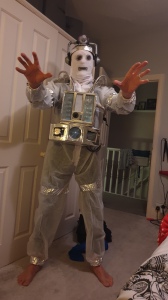
























































 The Jobbing Scriptwriter